


- Artificial Intelligence
- Mobile Design
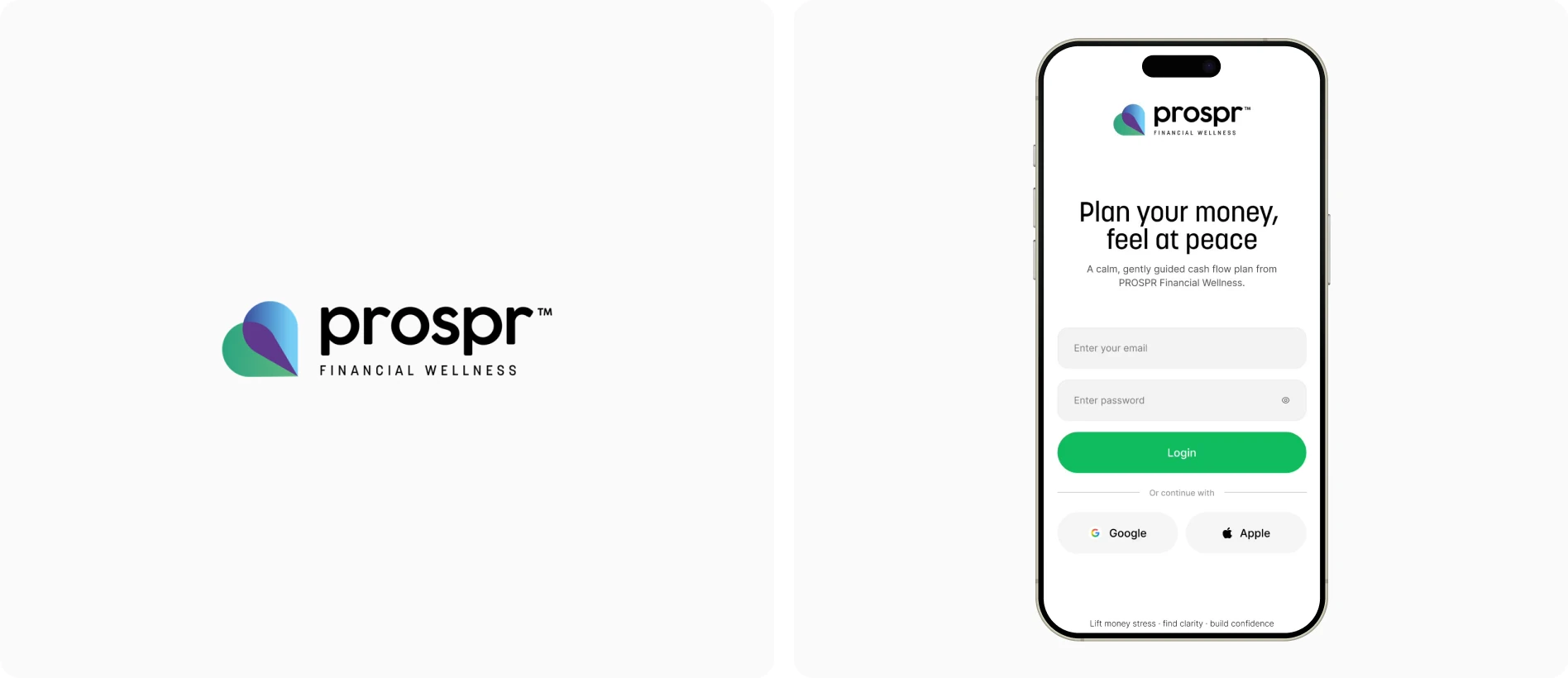

The task was to design an onboarding where UI mattered less and the onboarding logic mattered more
Improving design was a later step and having a clear direction of how the onboarding would work was the actual task, hence, this project was more about research, solving the problem in the right way, and then presenting it in high-fidelity design which can be improved later.
Prospr is a budgeting app built around one promise: plan your money, feel at peace. The existing app couldn’t keep that promise for a single new user as there was no onboarding at all but a “contact the team” button.
Search “The Prospr Plan” on the Play Store and you’d land on a Google login screen. Sign in, and the next screen told you that you weren’t registered, contact the team. That was the whole experience, not a rough onboarding, no onboarding at all.

One detail raises the stakes on everything after this: Prospr is built specifically for people with ADHD. Every extra step in an app like this isn’t just an inconvenience, it’s a real chance to lose someone for good.
Every budgeting app wants to be “thorough” which is the wrong instinct for this brain...
Most budgeting apps ask a lot up front, income, goals, categories, household setup, on the logic that more setup means a more accurate budget later. That logic works against ADHD specifically. Each extra question adds cognitive load, and cognitive load is exactly what makes someone close an app and never reopen it.
The real question wasn’t “what does a complete budget need to know,” it was “what’s the least I can ask and still end up with something that works,” and there was one week to answer it, a week that also had to cover research, testing the broken live app, and a founder call.

I ordered the questions by what they cost an ADHD person to answer, leaning on a specific psychological lever driven from my research and empathy mapping of ADHD people
Name costs nothing. Who you’re budgeting for costs a little. What feeling good about money looks like costs some real thought, but it’s still a feeling, not a number. Income costs the most, so it goes last, with a skip built in.
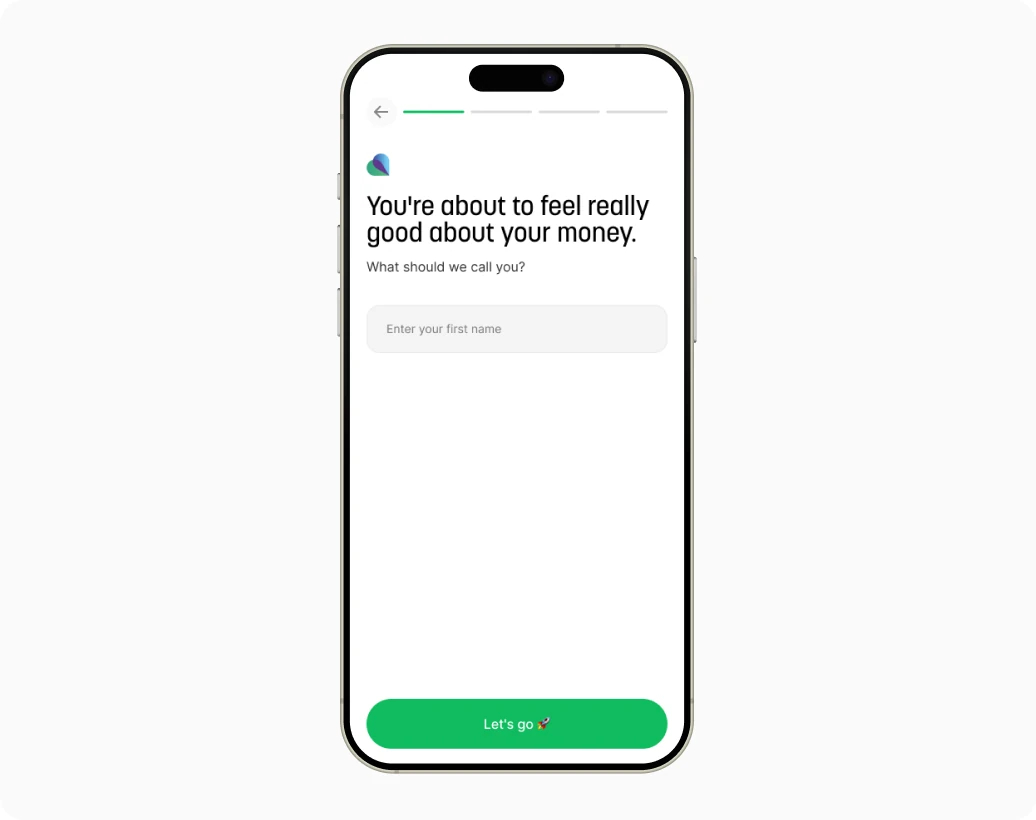
Opens on the lowest-effort question possible, cutting the activation energy needed to start at all. Every screen after this one addresses “Justin” directly instead of “the user,” a straight application of the self-referencing effect, information tied to your own name gets processed and retained more readily than generic phrasing.
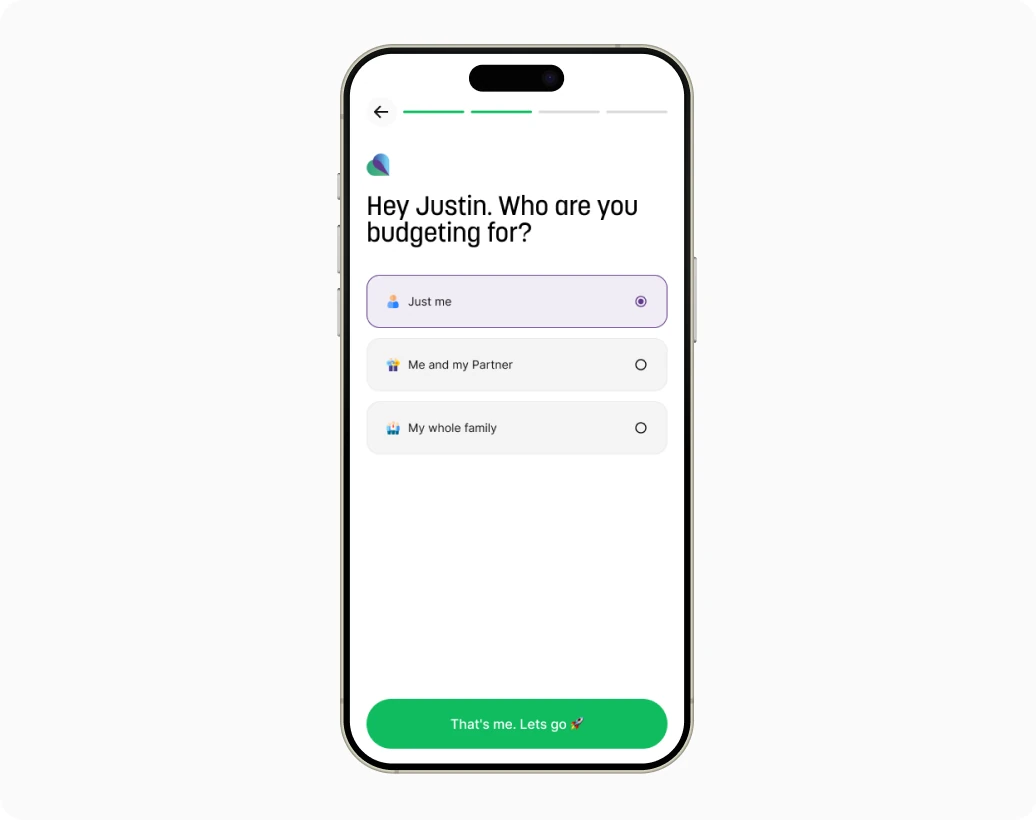
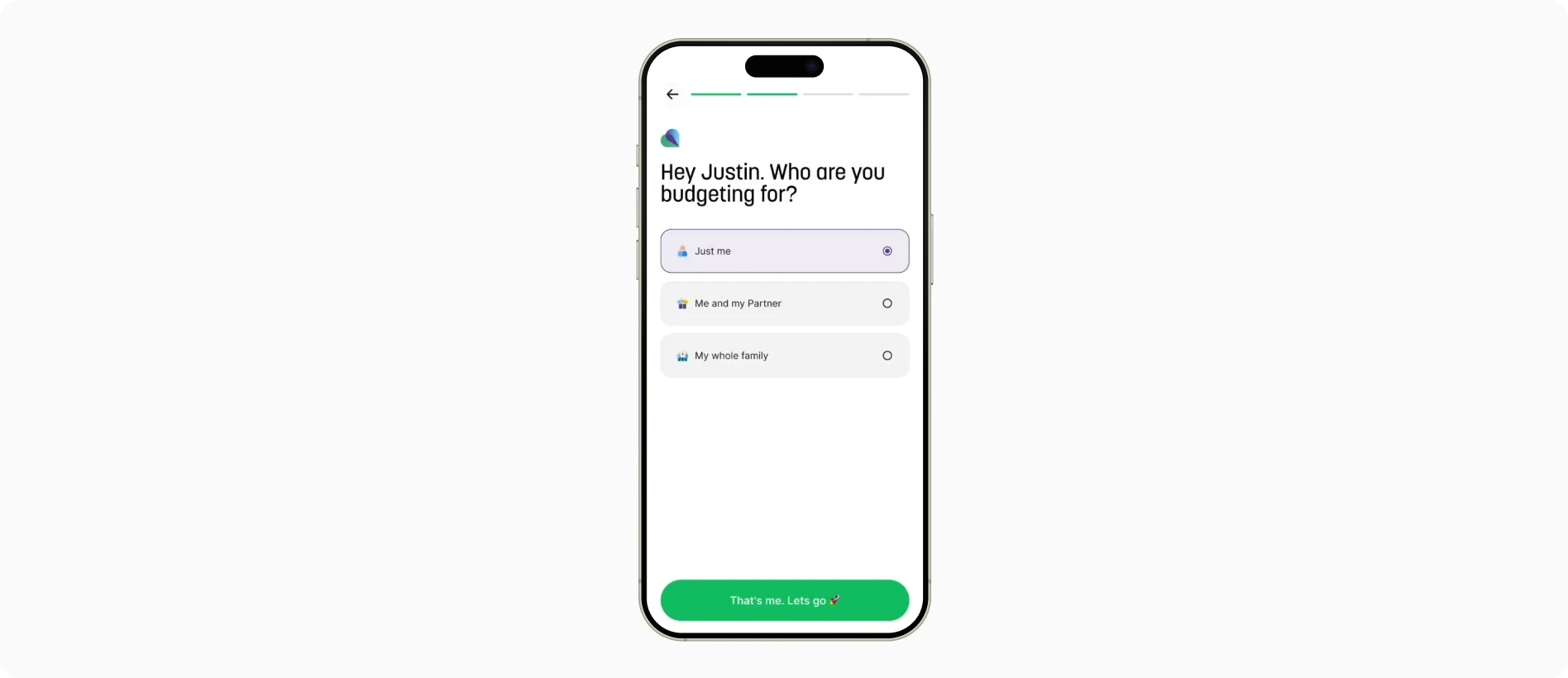
Who are you budgeting for. “Just me” comes pre-selected. That’s default bias from choice architecture, a pre-set default lowers the cost of deciding, which matters specifically here since decision-initiation is one of the executive functions ADHD affects most.
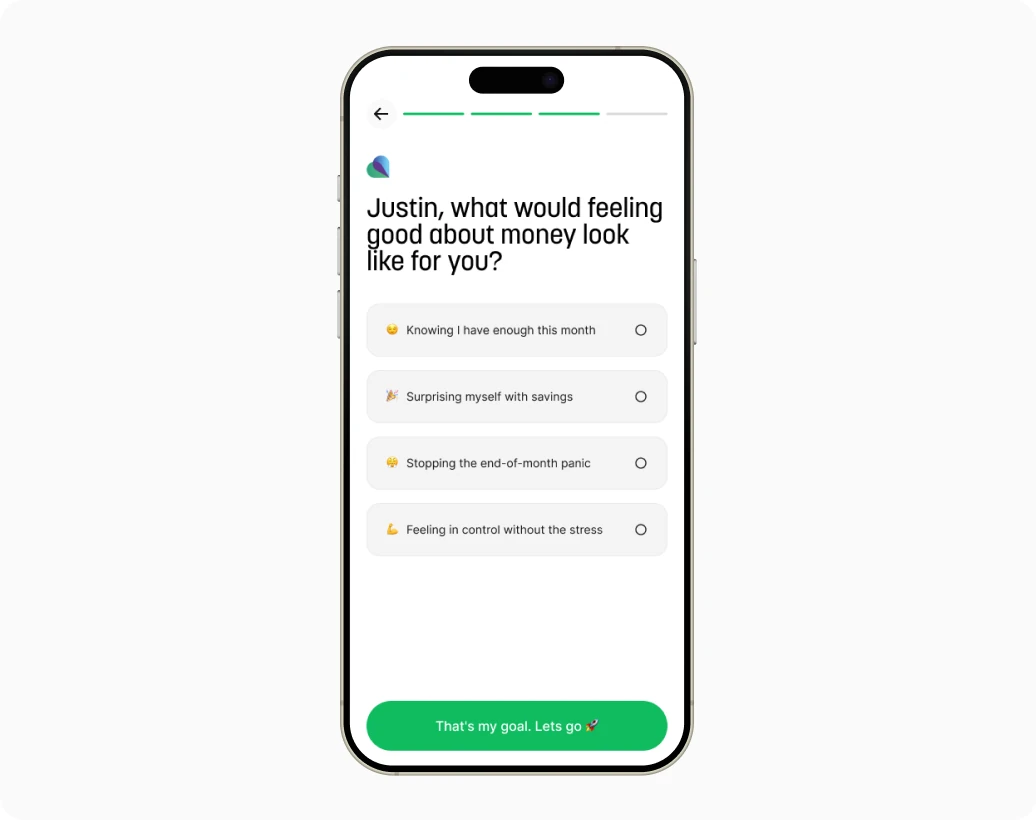
The goal question. Asks for a felt outcome, “what would feeling good about money look like”, instead of a number. That sequences an approach goal ahead of any administrative task, self-determination theory’s term for a goal framed around moving toward something wanted, anchoring the flow in intrinsic motivation before asking for effortful input.
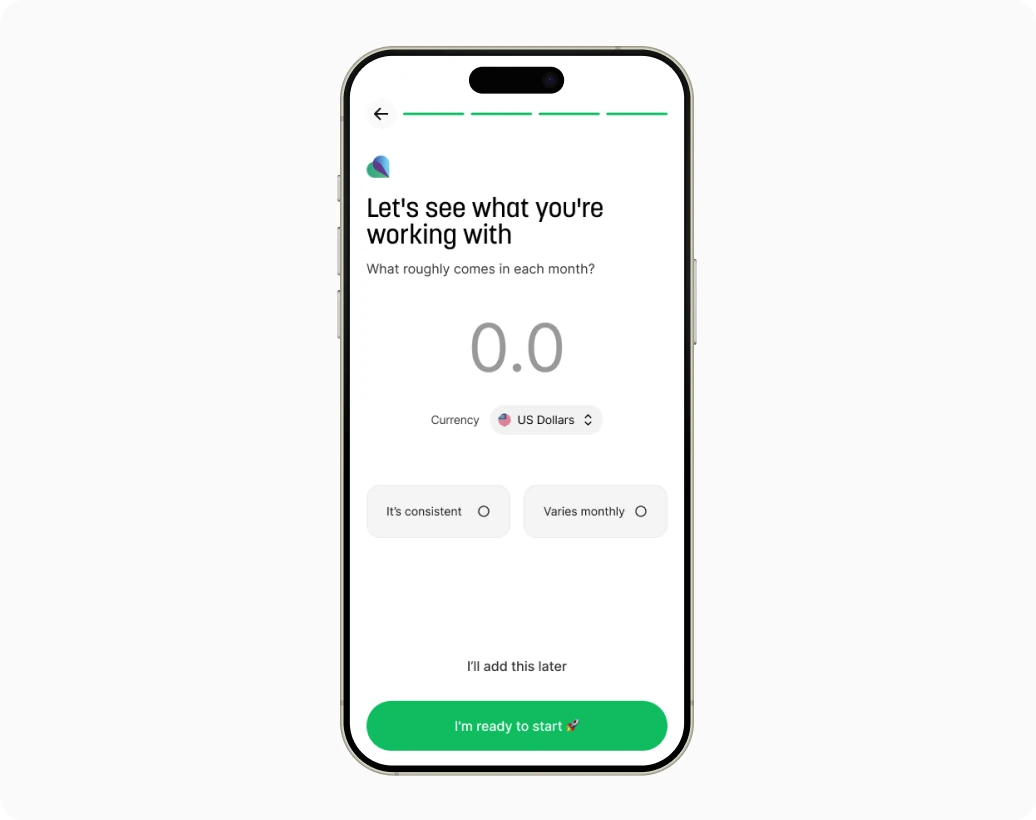
Income. Placed last on purpose. It’s the most executive-function-heavy question in the flow, recall, estimation, math, so it lands after momentum is already built, the goal-gradient effect, motivation increasing as a visible finish line gets closer. The “I’ll add this later” skip and the binary “consistent / varies” toggle exist so this screen can’t become a hard blocker, a frictionless exit built as executive-function scaffolding rather than a failure state.
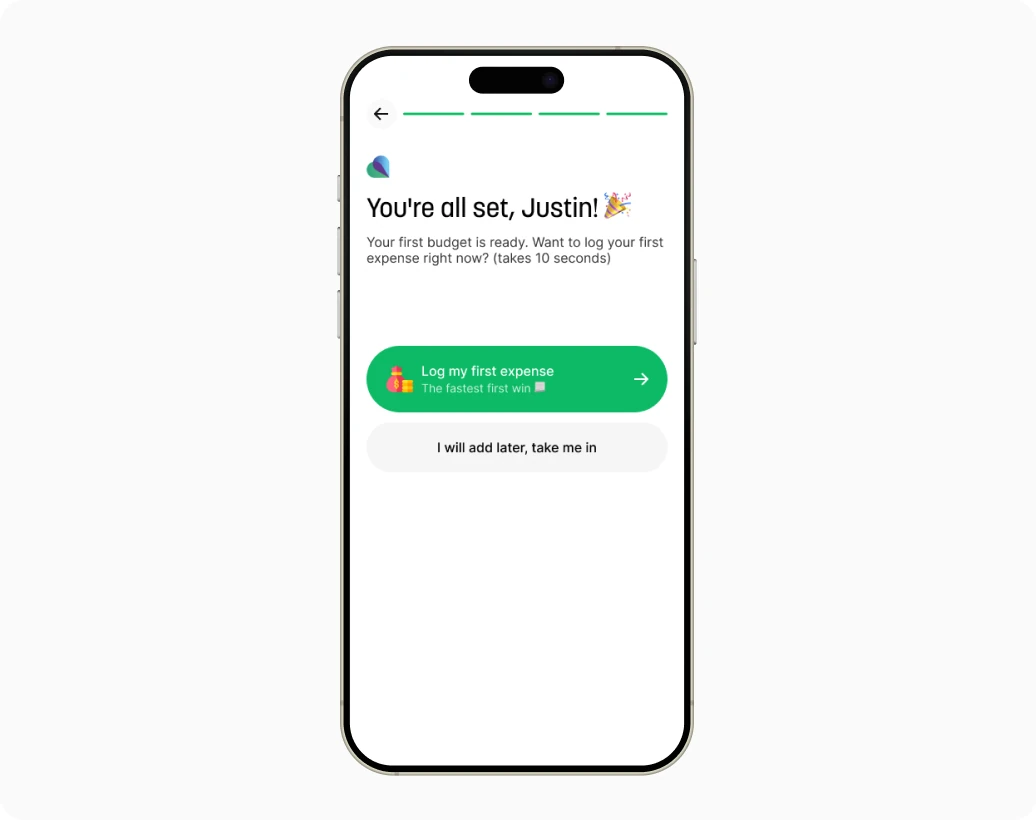
Completion. “The fastest first win” isn’t just copy, it’s a reward loop, turning finished onboarding straight into one tiny, completable action before the momentum from finishing has a chance to fade. ADHD research on delay aversion points to a stronger response to immediate reward over delayed reward, which is exactly what a 10-second first action is built to use. The secondary “I will add later” option keeps that first win optional instead of coercive, autonomy preserved instead of traded for a completion number.

The original plan put “add your partner” inside onboarding as a required step. I turned it into one optional question instead.
Most people using Prospr are stressed about household money, not just their own spending, so the obvious move is to build a shared budget from day one. For ADHD, that’s a trap. Shared responsibility without one clear owner tends to collapse into “I’ll do it later,” then “I thought you were doing it,” then nobody logs anything. The reward loop that makes budgeting stick, that hit of “I saved $200 this week,” also lands differently as a personal win than as a household stat nobody owns.
So “who are you budgeting for” became one question inside the flow, visible from screen one, with the real setup living in settings whenever someone’s ready. I did added a way to add partner if someone wants to do it right away but it was also accompanied with a “I’ll do it later” button and “Just me” selected as default. Nothing hidden, nothing forced. That call was contested with the founder, and it held.
What I learned
Cognitive load, not time, is the real cost of an extra question. Thirty seconds doesn’t sound like much until you’re asking someone whose attention is already working against them to spend it on a question that isn’t the point.
Making something visible and making it mandatory are two different decisions. The household feature didn’t need a setup step to exist, it needed one line saying it was there. Treating “exists” and “required” as the same choice is where onboarding quietly gets heavier than it needs to be.
